
The Yes-No Spectrum for People Pleasers
July 7, 2025
If you tend to say yes too frequently to requests from others, at the expense of your own well-being, saying no can feel like an impossible task…even if you know it’s something you’d like to do more of.
You often feel pulled by the desire to be helpful, maintain connection, or be a good friend/wife/employee/daughter/etc. You may enjoy being seen as reliable, and you’ve probably been affirmed, promoted, or valued for your dependability.
But what happens when that automatic yes starts to come at the expense of your time, energy, and well-being?
One trap that people pleasers often fall into is thinking of “yes” and “no” as the only two options when you’re asked to do something, as if it’s a multiple-choice question with only 2 answer options.
In cognitive behavioral therapy, we call the tendency to see things as “either/or” situations all-or-nothing thinking.
But what if we reimagined yes and no as two ends of a spectrum, with lots of space in between?
Or even better, what if we interpreted requests for help as open-ended questions instead of multiple-choice questions?
⚠️ Note: Seeing things as “either/or” isn’t always problematic. For instance, if you need to make a quick decision about whether to run away from a vicious bear, you don’t have time to think about the full spectrum of responses. I’m referring to situations where there isn’t a clear need or circumstance for an immediate yes-or-no answer.
What does the Yes-No Spectrum look like?
Imagine a horizontal line with Yes on one end and No on the other end. In between these two extremes, there are an infinite number of options, including the mid-point of “I don’t know”.
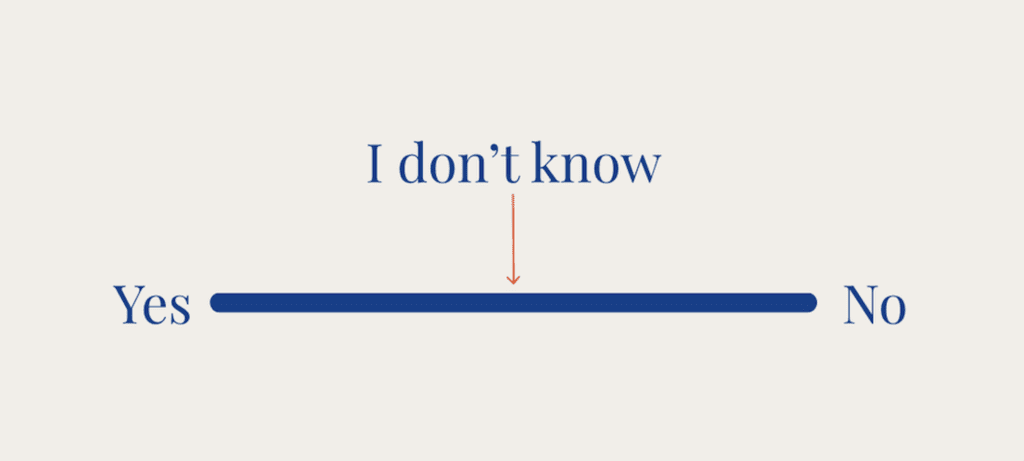
Let’s break this down a bit further…
From a spectrum standpoint, “yes” doesn’t have to mean total agreement or full responsibility. It could mean:
- “Yes, but not right now.”
- “Yes, but I can only help with this one piece.”
- “I want to, but right now, I am super busy. Can you check in with me again next week?”
Similarly, “no” doesn’t have to be harsh or final. It could sound like:
- “I can’t do all of those things, but I’m happy to take on this one piece.”
- “I wish I could help, but I’m really pressed for time right now.”
- “I can’t take this on, but here’s someone else who might help.”
The “I don’t know” option is a game-changer
If you’re trying to break the habit of saying yes as a reflex, allowing yourself to think or say “I don’t know” can be incredibly freeing. It forces you to pause, which then buys you time to think, check in with your values, and consider your current bandwidth.
Half the battle is just taking that pause! Once you’re there, you are much better positioned to find an honest and thoughtful response.
My most recent “I don’t know” response
A colleague recently invited me to consider a leadership position in a professional organization. Now, at the start of 2025, I promised myself that I would not take on any additional roles for the rest of the year.
Even so, I felt the urge to say yes (old habits are hard to break!) So I said to myself, “I don’t know if I should do this,” and I followed my 24-hour rule, which is to delay any decision by 24 hours to force myself to think.
The next day, I was confident that my answer was no. I responded with appreciation, explained my prior commitment, and felt lighter afterward (which validated my decision).
And my colleague was totally understanding, as I knew she would be.
Final thoughts
So the next time you feel torn, remember the Yes-No Spectrum. Start with “I don’t know,” and give yourself room to find a response that reflects your values, not just your fears. You’ll show up more authentically, honor your own limits, and likely still maintain the respect and trust of the people around you.
SUBSCRIBE TO MY NEWSLETTER
Real talk & Research for women of color who lead

